



The Amateur’s Guide to Breeding New Sweet Peas
Creating a brand-new sweet pea variety is one of the most thrilling experiences a home gardener can undertake. While professional breeders have introduced thousands of varieties, some of the most spectacular modern flowers are the result of amateur crossing and selection. By starting with strong, high-quality parent plants and understanding a few basic rules of genetics, any dedicated gardener can successfully hybridize their own unique blooms.
Understanding Sweet Pea Biology
To cross-breed sweet peas, you must first understand how they reproduce. Unlike many garden flowers that rely on bees for pollination, the sweet pea is naturally self-pollinating.
Both the male organs (the pollen-producing anthers) and the female organs (the stigma and ovary) are tightly enclosed within the boat-shaped "keel" petals. Fertilization typically takes place very early, while the flower is still tightly closed in the bud stage, meaning that by the time the petals open, the flower has already pollinated itself.
Because insects cannot easily access the pollen or the stigma, you must manually intervene before the bud matures to create a cross between two different varieties.
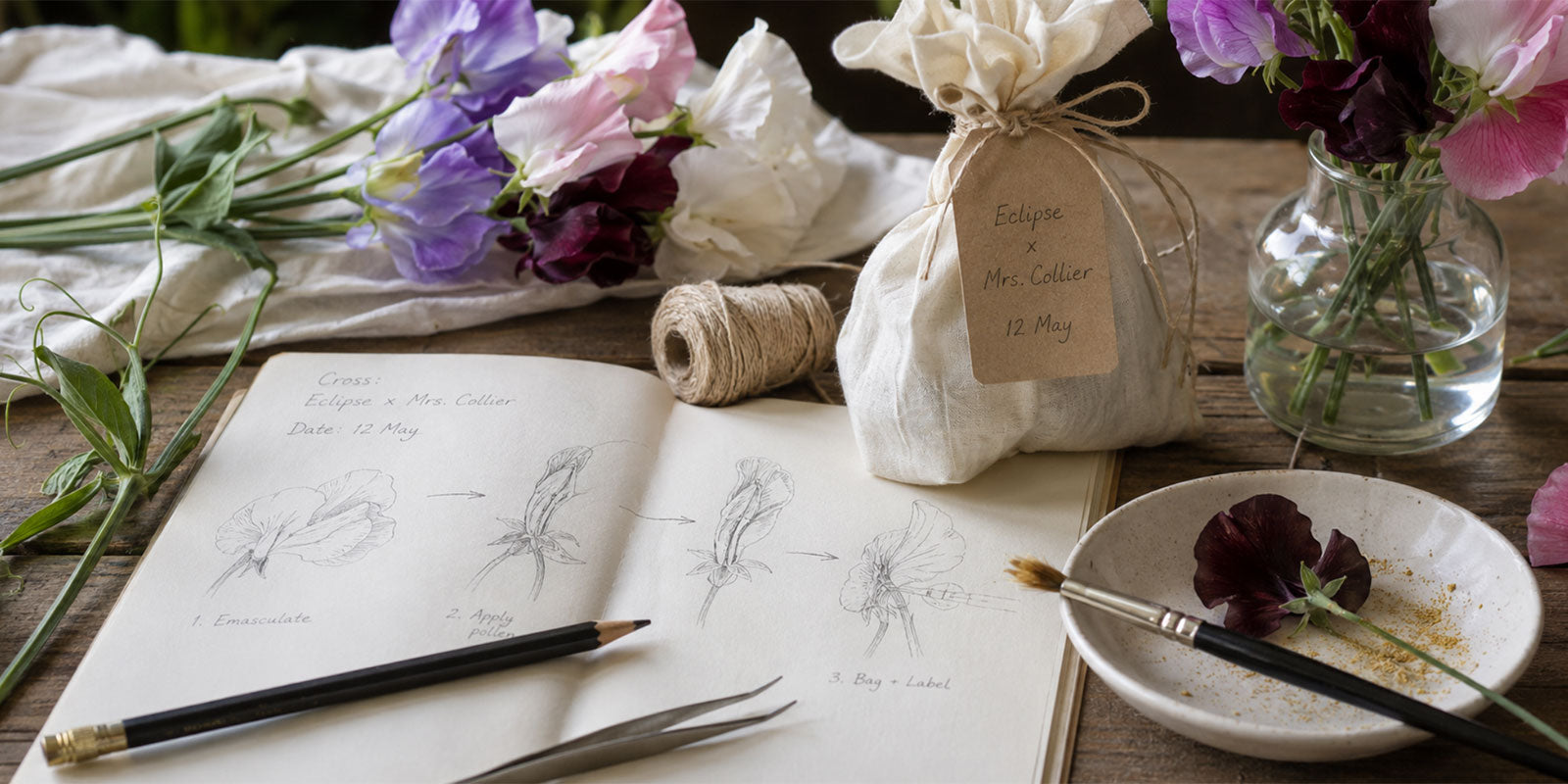
Step 1: Emasculation
The first step is to remove the male parts of the flower you have chosen to bear the seeds (the seed-parent) so it cannot self-pollinate.
Timing
Select a bud that is about half-developed, well before the petals begin to unfurl or show full color.
The Cut
Gently hold the bud and fold back the standard and wing petals. Using a clean needle, a small pair of pointed tweezers, or fine scissors, carefully slit the keel open from bottom to top.
Removal
Inside, you will see the pistil surrounded by ten anthers. Before these anthers have burst and shed their powdery pollen, carefully pinch or snip all ten of them off, making sure not to damage the central pistil.
Step 2: Cross-Pollination
Now you must introduce the pollen from your chosen "father" plant (the pollen-parent).
Applying Pollen
You can apply the pollen immediately, or wait two to three days for the seed-parent's stigma to become fully receptive. Find a flower on your pollen-parent that is about three-quarters open, with anthers that have burst to reveal dry, yellow, powdery pollen.
The Transfer
You can use a soft camel-hair brush to transfer the pollen, but the easiest method is to simply pluck the pollen-parent bloom, expose its pollen-covered stigma, and brush it directly against the stigma of your emasculated seed-parent.
Protection
To guarantee that no stray pollen from wind or a rare insect disrupts your cross, cover the newly pollinated bud with a small muslin bag, tissue paper, or a greaseproof paper bag. Always attach a label to the stem recording the names of the two varieties crossed.
Step 3: The Waiting Game (Mendel's Generations)
Once the seed pod ripens, harvest the seeds. From here, you must follow the laws of heredity discovered by Gregor Mendel to stabilize your new variety.
The F1 Generation (Year 1)
When you plant your crossed seeds the following season, the resulting plants are called the F1 generation. Do not be disappointed if they look nothing like the beautiful cross you envisioned—they will often take on the "dominant" color traits of their lineage, frequently reverting to ordinary purples or pinks. Simply allow these F1 plants to naturally self-pollinate and save their seeds.
The F2 Generation (Year 2)
When you plant the F1 seeds, the magic happens. This F2 generation will split into a kaleidoscope of different colors and traits as the hidden "recessive" genes finally emerge.
Walk your rows daily, observing the flowers in different lights. When you find a spectacular, completely new seedling, tag it. You must save the seed from this specific plant entirely separate from the rest.
The F3 Generation & Fixing (Year 3+)
Plant the seeds from your selected F2 plant. Some will breed entirely true to type (meaning they are "fixed"), while others will continue to throw mixed colors or "rogues". Pull out any rogues immediately.
You must continue to save seeds from the best single plants each year until the entire row blooms uniformly.
The Long-Term Reward
It can take anywhere from five to ten years to fully stabilize a new sweet pea variety for the market. However, the intense fascination of watching the blooms open in the F2 generation, combined with the possibility of bringing an entirely new floral beauty into the world, makes the patience well worth the effort.
Leave a comment
This site is protected by hCaptcha and the hCaptcha Privacy Policy and Terms of Service apply.