






How Sweet Peas Became the Queen of Annuals
The journey of the sweet pea from a modest wildflower to a global horticultural sensation began in 1695 or 1696 when an Italian monk and botanist named Father Franciscus Cupani discovered the wild sweet pea (Lathyrus odoratus) growing near Palermo, Sicily.
This original wild plant looked quite different from the large, ruffled blooms we know today. It was a bushy climber bearing small flowers with maroon upper petals (standards) and purple-blue lower petals (wings), and it typically produced only two flowers per stem. However, what it lacked in size, it made up for with a remarkably intense and beautiful fragrance.
We know this because the authentic original plant was successfully identified in modern times by the renowned breeder Dr. Keith Hammett. By analyzing the genetics of available heritage seeds, Hammett isolated the most primitive form of the flower—now known as 'Cupani Original'—proving it to be an exact match to Cupani's 17th-century descriptions and illustrations.
How Sweet Peas Reached Europe
The spark that would eventually ignite the craze occurred in 1699, when Cupani sent seeds of his fragrant discovery to botanical correspondents across Europe, most notably to Caspar Commelin in Amsterdam and Dr. Robert Uvedale in Enfield, England. Dr. Uvedale successfully cultivated the seeds in his garden, officially introducing the species to Britain and laying the very first foundation for the world's fascination with the flower.
From Garden Curiosity to Floral Craze
Despite Cupani's introduction, the sweet pea did not immediately become a mainstream craze. For nearly two hundred years, it remained a relatively simple garden plant with only a handful of color variations available, such as the famous pink and white 'Painted Lady'.
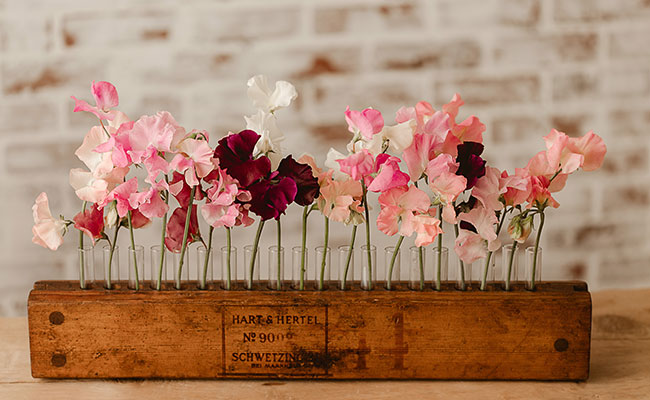
The actual "craze" was finally ignited in the late 19th century by a Scottish horticulturist named Henry Eckford. Starting in the 1870s and 1880s, Eckford took the descendants of Cupani's wild pea and began a patient, painstaking process of cross-breeding. He successfully developed the Grandiflora class, transforming the small, simple flower into a much larger, more robust bloom available in a vast array of new colors.
The Rise of Commercial Sweet Peas
Eckford's beautiful new Grandifloras caused a horticultural sensation, and demand skyrocketed. His seeds were soon shipped to the United States, where entrepreneurial seed giants like W. Atlee Burpee & Co. and C.C. Morse & Co. began cultivating them on a massive agricultural scale in the ideal climate of California.
Ultimately, it was the combination of Cupani's serendipitous discovery of a highly scented weed, Eckford's masterful 19th-century breeding, and American commercial mass-production that sparked the craze and elevated the sweet pea to the globally beloved "Queen of Annuals".

Leave a comment
This site is protected by hCaptcha and the hCaptcha Privacy Policy and Terms of Service apply.