Quick Facts
- Botanical Name: Lathyrus odoratus
- Classification: Wild Species / Primitive Form
- Petal Pattern: Bicolour
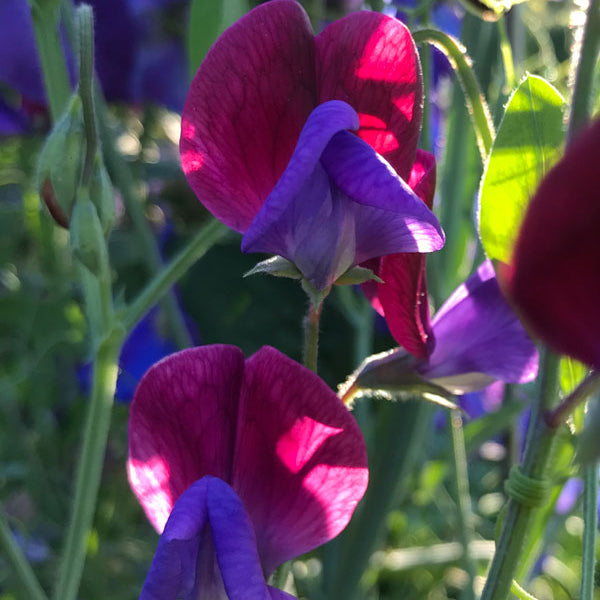
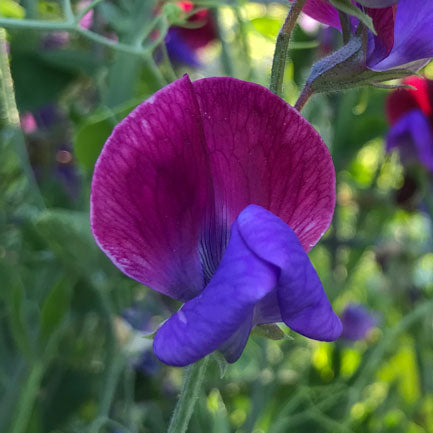
- Color Profile: Dark maroon standard and violet wings
- Fragrance: Highly scented / Intense
- Breeder: Originally discovered by Franciscus Cupani; modern primitive form selected by Dr. Keith Hammett
- Year Introduced: 1699 (Original discovery)
- Flowering Type: Summer
Overview
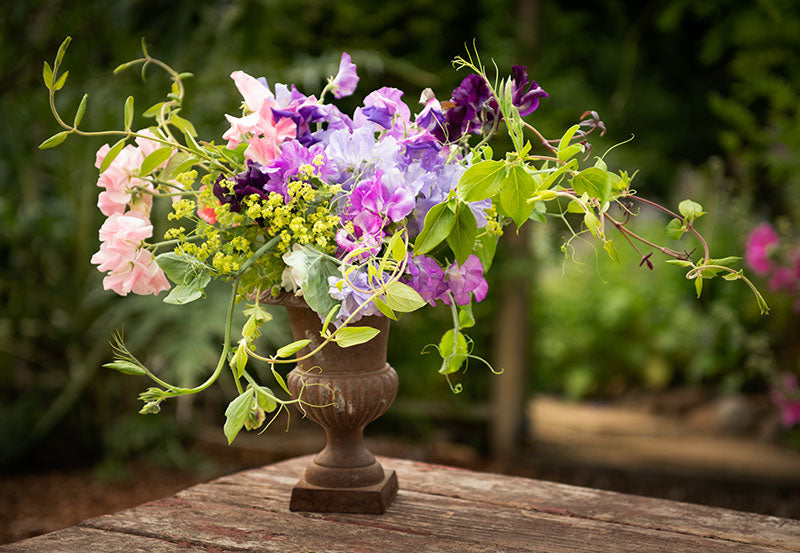
'Original' (most frequently sold as 'Cupani Original' or simply 'Cupani') represents the absolute most primitive known form of the sweet pea. Dr. Keith Hammett selected this specific form out of all available cultivated material because his detailed genetic studies proved it was the most primitive, perfectly matching the earliest illustrations and botanical descriptions of the wild sweet pea. It features a dark maroon standard and violet wings, with a noticeably smaller flower size but a much more intense fragrance than modern grandiflora types.
Growth Habit
This variety is an easily grown, vigorous, bushy climbing vine. Unlike modern Grandifloras or Spencers, it produces only two flowers per stem, which is a key botanical marker of its primitive wild status (originally classified by Linnaeus under Pedunculis bifloris, or two-flowered Lathyrus species).
Cultivation Notes
As a wild, primitive form, it is very robust and well-suited for a sunny spot in the garden. Because it is categorized as a summer-flowering variety, it requires longer daylight hours (at least 12 hours) to successfully initiate its blooming cycle.
Historical Notes
The wild Lathyrus odoratus was first described by the Sicilian monk Franciscus Cupani in 1696, and he introduced it to cultivation by sending seeds to England and Amsterdam in 1699. For many years, there was widespread confusion between this original form and a variety named 'Matucana', which was collected in South America in the 1950s by Professor S.C. Harland and dates only as far back as the 1920s. Dr. Keith Hammett's genetic studies definitively separated the two, isolating the true primitive form—now known as 'Cupani Original'—from the 1920s cultivated material.
In the Garden
Grown for: Its intense, complex wild fragrance, historical garden displays, and vibrant maroon/violet bicolour blooms.
Companion Planting: Pair with other heavily scented heirloom and primitive types (like 'Matucana' or 'Flora Norton') to create a deeply fragrant historical garden, or use as a bushy climber over low natural trellises alongside bright summer annuals.