




Sweet Pea Seed Soaking Test: Soaked vs. Unsoaked Germination Rates
If you've grown sweet pea seeds before you will probably have heard that you should soak your seeds. And... you've probably also heard that you should not soak your seeds. Soaking sweet pea seeds is supposed to soften the tough outer skin so that the seed can germinate more easily. BUT, some experts will say that soaking will reduce the germination.
My Current Sweet Pea Seed Soaking Method
This experiment tested just one sweet pea variety, using freshly harvested seed. Since carrying out this trial, I have germinated many different sweet pea varieties and found that seed coats can vary considerably.
I now recommend soaking sweet pea seeds in room-temperature water for about 12 hours before sowing. Seeds that have absorbed water will usually swell noticeably. If a seed remains hard and unchanged after soaking, I carefully nick the seed coat on the side opposite the hilum before sowing.
Sweet Pea Seed Soaking — Results at a Glance
- Unsoaked seeds: 100% germination
- Soaked seeds: 94% germination
In this trial, fresh seed of this particular variety germinated beautifully whether it was soaked or sown dry. However, this experiment used only one cultivar, and different sweet pea varieties can have noticeably different seed coats. See the full test, photos and my current recommendations below.

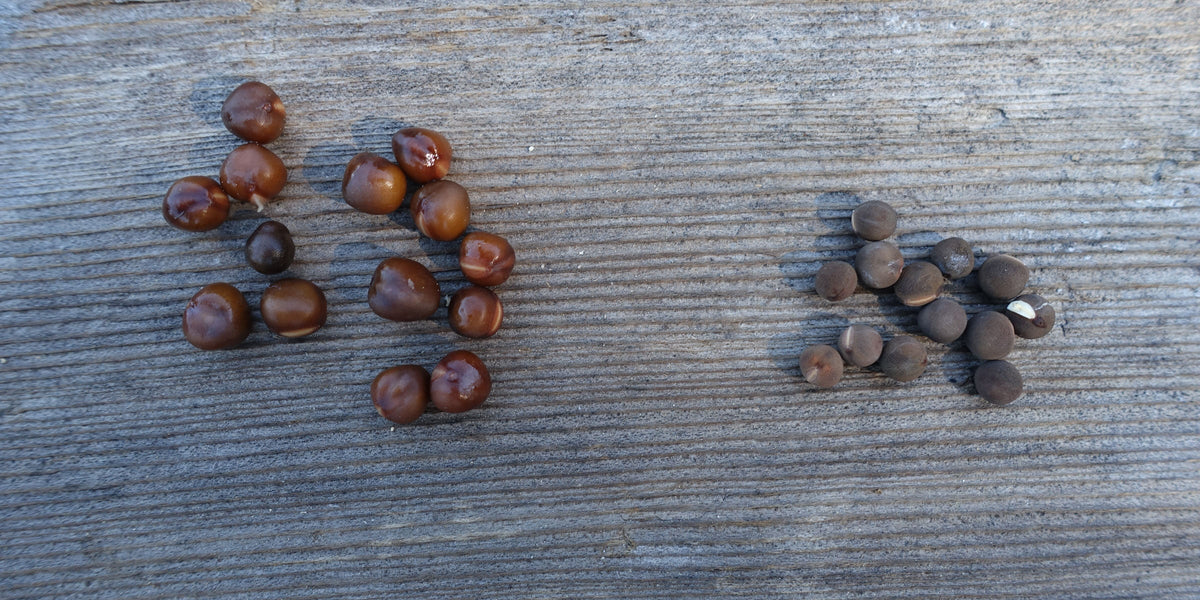
Half of the sweet pea seeds were soaked and half were left dry.

After 12 hours of soaking, the two lots of sweet pea seeds look different.

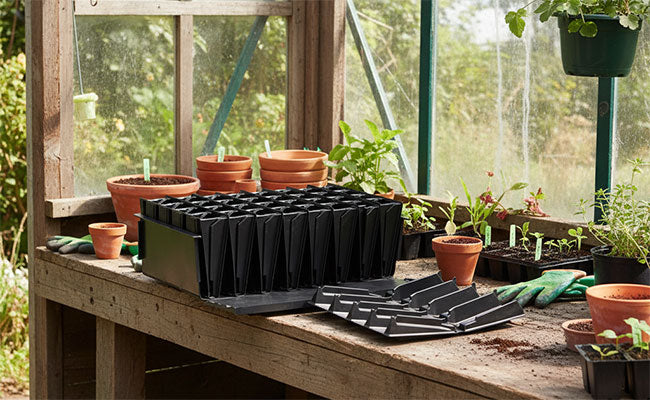
Two seed trays were filled with potting soil.

The planting depth of each seed was carefully measured using a pencil as a measuring stick.

The sweet pea seeds waiting to be covered with potting soil.

The planted seeds were kept at 63°F.

The sweet pea seeds germinated on Day 3 and were then placed in full light.
It's conflicting advice and confusing too because I have soaked sweet pea seeds and they have grown. And... I have sown seeds just as they are and they have grown. I find that sweet pea seeds usually have a very high germination rate if using fresh, good quality seed, but I had never kept a tally of how many seeds germinated using the soak or no-soak methods and I never expected it to be 100% either way.
Finding I had a little extra time this autumn, I thought that I would do a small trial to find out what germination rates I got with soaked and unsoaked seeds. I tried to set this experiment up as scientifically as possible (yes, I thought back to high school days of science class reports comprised of 'Aim', 'Method' and 'Conclusion'), but it was just a test carried out in my boot room, so take from it what you will!
I started with a few hundred sweet pea seeds — all freshly harvested that year and of the same cultivar. I then selected 100 seeds that were uniform in shape, size and color and divided them into 2 groups of 50 and placed them in jam jars.
50 seeds were soaked in room-temperature water for 12 hours and 50 seeds were left dry.
Meanwhile I prepared two identical 50-cell seed trays with moistened potting soil.
Soaked vs Unsoaked Sweet Pea Seeds — Quick Comparison
| Method | Prep | Time before sowing | Steps | Pros | Watch-outs |
|---|---|---|---|---|---|
| Unsoaked | None | Immediate | Fill cells with moist mix → sow approximately ¼″ deep → keep evenly moist → provide light after emergence. | Simple and can work extremely well with varieties whose seed coats readily absorb moisture. | Some varieties have particularly hard seed coats and may absorb water slowly or inconsistently without additional preparation. |
| Soaked (12 hrs) | Room-temperature water | Approximately 12 hours | Soak for approximately 12 hours → sow swollen seeds → nick any seeds that remain hard and unchanged → sow into pre-moistened mix. | Allows seeds to begin absorbing water before sowing and makes it easy to identify seeds with particularly hard seed coats. | Do not leave seeds soaking indefinitely. After approximately 12 hours, sow swollen seeds and nick any that remain hard. |
In my small trial with fresh seed of one cultivar, unsoaked seeds reached 100% germination and soaked seeds reached 94%. My current method is to soak for approximately 12 hours and nick any seeds that remain hard and unswollen.
Planting Depth
Over the many years I have grown sweet peas, I have always thought that one major factor that influences how many baby plants I get is the depth at which the seed is placed in the soil. The general rule of thumb is that a seed should be planted 2 or 3 times as deep as it is wide. However, I have found that sweet peas germinate better for me if planted a little more shallow than that - about a ¼ inch deep seems to work well.
I use a Ticonderoga pencil to make the holes for my sweet pea seed because the rings on the end are conveniently spaced at ¼ inch (remove the eraser to make this work!). Take a ruler and pencil and you will see what I mean.
I followed this rule for this 'experiment' and made sure that each seed was covered by no more than ¼ inch of potting soil.
Temperature
The seeds were kept at around 63°F simply because that was the ambient temperature of the room they were in. Sweet pea seeds can germinate at lower temperatures, but this was the temperature I had.
Water
Once I planted the seeds, I did not water them again until I saw germination occur, i.e. seedlings start to emerge (always exciting, no matter how many times you see it!).
Light
I excluded light until germination occurred using a seed tray turned upside down over the plant cells.
Time
I observed the first signs of germination after 3 days, but I waited a full 14 days before counting how many seedlings I had in each of the groups. Once I saw babies emerging (day 3), I placed the trays in full light.
Results
Thank you for reading this far, or did you just skip down the page to the 'results' section? Either way, thanks for checking out my post!
In this particular experiment, the unsoaked, fresh, good quality seed had the highest germination rate. I got 100% germination from the unsoaked seeds! I was surprised at that because, as I mentioned above, I don't usually expect a 100% germination rate in ANY seed I plant.
The soaked seed didn't do too badly either. Only 3 of the seeds failed to germinate. That means that the soaked seeds had a 94% germination rate. Doesn't sound too bad, hey? And really, for most of us, a 94% germination rate is going to be just fine.
So, Should You Soak Sweet Pea Seeds?
There is one important limitation to this experiment: I tested only one sweet pea cultivar, and all of the seeds were freshly harvested. The 100% germination rate tells us that this particular batch of seed certainly did not need soaking in order to germinate. It does not necessarily tell us how every sweet pea variety will behave.
Since conducting this experiment, I have germinated many more sweet pea varieties and have seen considerable differences in their seed coats. Some absorb water readily, while others remain extremely hard.
For that reason, my current method is to soak sweet pea seeds in room-temperature water for approximately 12 hours. I then look at the seeds before sowing. Those that have swollen are planted as they are. If a seed is still hard and has not swollen, I carefully nick through the outer seed coat on the side opposite the hilum before planting it.
So, did this experiment prove that soaking sweet pea seeds is unnecessary? No. What it showed was that this particular variety, when fresh and of good quality, germinated extremely well without soaking. Different varieties may behave differently, which is why I now use the 12-hour soak as part of my regular sweet pea seed-starting method.
8 comments
I have been growing sweetpeas for almost a decade and this is my first year that after the seedlings reached 2-3 inches in incubation, when I planted them
Outside all the new growth died. Not sure if it was the soil amendments bugs ?? Very disappointing!
Kelly Yoshida
Thanks so much for sharing your experiment with the sweet peas. I have always soaked and planted far too many so great success rate. Maybe this year I won’t bother and see what happens. I have limited space so one packet will do.. Years past you got a lot in one packet – not many now. Anyway can’t do without them – so beautiful and perfumed. Thanks again and enjoy 😊
Elizabeth Weight
Thank you for sharing your experience as I don’t seem to be able to grow sweet peas successfully, so will follow your method this year and see what happens.
Gail
Hello! I just subscribed to your wonderful website!
I have a question as a new grower… I live in zone 8b (Portland, OR) and want to plant seeds in my community plot this fall. I do not have a greenhouse. Will the seeds still be okay, or is there another way to protect them over the winter?
Best,
Barb Johnson
Barb Johnson
Thank you! I hope my old ones germinate.
Kay Yamada
Hey! I like your post. I just nicked 48 seeds and am soaking. I’m going to count how many grow. I’ll find a place to plant more without nicking. I reallly don’t like waiting but don’t want to waste growing time or seeds! Thanks, Ann in Sacramento, Ca
Ann
Loved your experiment! I was a science teacher for 38 years and always think of scientific ways to find an answer!!
Looking forward to my first planting of sweet peas!!
Edna Mills
Thank you for this write up! Off I go to plant my unsoaked sweet peas! I am most excited for the pot luck ones.
Amanda
Leave a comment
This site is protected by hCaptcha and the hCaptcha Privacy Policy and Terms of Service apply.